What partial restumping covers
Partial restumping replaces some of the stumps under a house and relevels the floor on the result. Per stump it is the same work as a full restump: jack, cut out, dig, set, pack. The difference is that it stops where the inspection says the stumps are sound. It is priced per stump, with the set-up and any approval spread over fewer of them, so it only makes sense when the number of good stumps is large and they are not about to follow the bad ones. It is the wrong job for a house where most of the stumps are the same hardwood at the same age as the ones that have gone, and the full restump page explains when the whole house is the answer.
What makes a partial job different in Queensland is where it sits in the approval rules. Replacing a few stumps may be accepted development under Schedule 1 of the Building Regulation 2021, which covers repairs affecting only a minor structural component. Logan City Council's building approval fact sheet puts the line at restumping over 20% of the building's structural components, and Moreton Bay and Fraser Coast councils paraphrase the same rule. Toowoomba Regional Council's own page says most structural work needs approval and some minor work does not. We cannot tell you which side of the line your job falls, and neither can the builder: the certifier decides. Council's duty building certifier at the Toowoomba Service Centre on Tuesdays and Thursdays, 9 to 4.30, is the place to ask before anyone is booked.
When a partial job is the right call
- The house was restumped once already. Concrete stumps from a 1980s restump under the body of a Newtown Queenslander, and a laundry or sleep-out added later on its own hardwood stumps that have now rotted.
- One wet corner. The bathroom and kitchen side of a Harristown cottage where a leaking shower, or a downpipe that was never connected to stormwater, has rotted half a dozen stumps while the rest stand in dry ground.
- Termite damage in one run. Mud tubes and galleries in a line of stumps near where the nest was found, with the rest clean on inspection. QBCC says termites are a problem throughout Queensland, so the rest get probed, not assumed.
- A verandah or a chimney base. Verandah posts on short stumps close to the ground, and the heavier stumps under a hearth, fail first and can be done on their own.
- A building and pest report with a short list. A pre-purchase inspection on a Rangeville house that names four stumps. If the rest of the subfloor passed with photographs, four is the job. The buyer's guide covers what those reports do and do not tell you.
- A corner on fill. On a cut-and-fill block near the escarpment the downhill stumps have settled into the fill while the uphill ones sit on basalt and have not moved.
Choosing the replacement stump
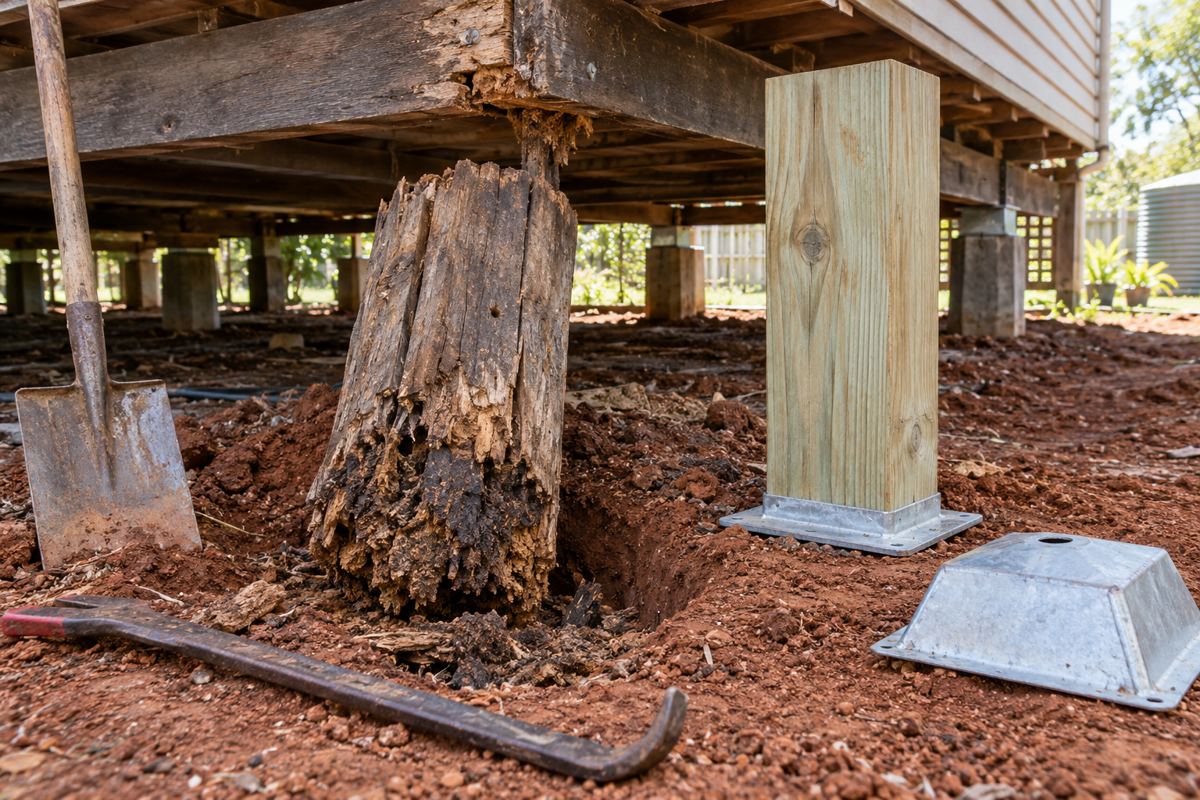
The new stump does not have to match the old ones. A hardwood stump that has rotted at the ground line after decades in red loam is replaced with precast concrete or hot-dip galvanised steel, not with more timber, because the NCC Queensland variation asks for termite management with a 50-year design life and neither concrete nor steel is eaten. Where the house already sits on concrete, concrete matches and the bearer is bolted down through the cast-in rod. Where the corner being done is the one that keeps moving on black clay, an adjustable steel stump there lets it be relevelled later with a spanner rather than another dig. The stump types page goes through the trade-off.
| What failed | Usual replacement | Why |
|---|---|---|
| Hardwood stump rotted at the ground line in red ferrosol | Precast concrete | Unaffected by damp; sits well on a sole plate in a hole that stands up. |
| Hardwood stump rotted or tilted in black vertosol | Precast concrete on a wider pad, or adjustable steel | Cracking clay moves with the seasons; a wider pad spreads the load, steel lets the corner be wound back up later. |
| Concrete stump sunk or cracked | Precast concrete, deeper hole | The old one was founded too shallow; the new one goes to firm ground and matches the rest of the house. |
| Stump under a low verandah or sleep-out, no room to feed a precast post in | Short galvanised steel stump on a poured pad | Pad poured in place, post cut to length, head wound to level. |
| Termite-eaten hardwood stump | Concrete or steel with an ant cap, bearer checked | Neither is eaten; the ant cap makes any new tunnel visible at the yearly inspection QBCC recommends. |
How the work runs
- Inspection. Every stump is probed, not only the ones on the building report, because the cheapest time to find the next rotten one is while the crew is already under the house. The owner gets photographs with the stump count.
- Certifier's call. With the count known, the builder or the owner asks a licensed building certifier whether the job is accepted development or needs a building development permit. Over the 20% line it is a permit, with inspections at footings and final.
- Quote and contract. The stumps named by position, the type, the depth, relevelling of the affected bearers, ant caps, and what happens if a bearer above a stump is soft. Between $3,301 and $19,999 that is a Level 1 contract, written, dated and signed before work, with the deposit capped at 10%. At $20,000 or more it is Level 2, with a 5% cap, a start date and the Consumer Building Guide. Under $3,300 no contract is required and a 20% deposit cap applies.
- Licence. Over $3,300 the builder needs a QBCC licence in a class that covers the work, which for a house is Builder Low Rise or higher. The historical repairs-and-maintenance class cannot add a foundation or alter a loadbearing member, so it does not cover stump replacement, even for a handful.
- Replace. Jacks take the load either side, the old stump is cut out, the new hole goes to firm ground, the new stump is set plumb with its ant cap, backfilled and rammed, and the bearer is packed level to the rest of the house.
- Sign-off. Where there is a permit, the certifier inspects and closes it with a final certificate. Keep it with the house papers; the next building inspector will ask, and council's building plan search only goes back to 1975.
What Toowoomba adds
The wet corner after a storm. The Bureau's long city record puts January at 132.1 mm, the wettest month, against a winter that is dry enough for the black clay to crack. The stumps that fail first are the ones under the wet areas and on the side the block drains toward, so a partial job is usually one side of a house. Doing that side without fixing where the water comes from means doing it again. Regrading the ground under the house and connecting the downpipes are part of a partial restump here, not an extra.
The high-set Queenslander. Under a high-set house in East Toowoomba or Newtown the stumps are tall, the crew can stand up, and a single stump can be done in a morning once the permit question is settled. The catch is the enclosed under-house: where the space below has been battened in and used as a laundry or workshop for fifty years, the stumps along the enclosed wall have had the least air and are the ones to probe hardest.
The post-war low-set. Under a 1950s Harristown or Wilsonton cottage there may be 400 mm of clearance. A partial job there is a crawl, and short steel stumps on poured pads are often the only thing that will fit.
Termites and the 50-year rule. With the building code requiring a termite management notice in the meter box and the Queensland variation setting a 50-year design life for termite management, ant caps on the new stumps and a yearly inspection are the baseline. A pest controller treating the house is a separate licensed job, arranged with the stump work so the new timber above is protected.
The owner-builder question. A partial job is the one owners most often think about doing themselves. Up to $11,000 of work on your own property needs no permit; above that QBCC requires an owner-builder permit, with a course, one permit per 6 years, no Home Warranty cover, a notice on the title for 7 years and disclosure on sale within 6 years. The jacking is the part that goes wrong, and it goes wrong with the house on it.
Whether to relevel the rest while the crew is there
Replacing six stumps brings the bearers over those six back to level. The rest of the floor stays where it is, and on a house that has been settling for seventy years that can leave a step in the hallway between the new line and the old. The choice is whether to relevel the whole floor on the sound stumps while the jacks are already under the house, which adds a day and some packers, or to accept the step and keep the job small. For a house about to be sold the whole-floor relevel is usually worth it, because a building inspector reads a stepped floor as unfinished work. For a house the owner plans to keep, a small step is often lived with. Either way it should be a decision in the quote rather than a surprise on the last day, and the relevelling page explains what packing on sound stumps involves.
The Queensland Home Warranty Scheme is worth knowing about for a job this size. It applies to residential work over $3,300, the builder collects the premium through the contract price and pays it within 10 business days of signing and before work starts, and structural defects are covered for 6 years 6 months from the contract date. Many partial restumps sit near the $3,300 line, so ask the builder which side the quote falls and ask for the QBCC insurance notice if it is over.
What partial restumping cannot fix
It cannot make the remaining old stumps younger. If they are the same hardwood in the same ground, they are on the same clock, and a partial job that ignores that is a deposit on a full one. It cannot level a floor evenly if the untouched stumps have sunk at different rates; the relevel is limited to the bearers being worked unless the quote includes the whole floor. It cannot decide for itself whether it is accepted development or needs a permit; the certifier does that against the 20% line. It cannot dry a wet side of the house; that is drainage, done with it. And it cannot be done under a repairs-and-maintenance licence.
Check the current rules before you rely on this
This page describes partial restumping and single stump replacement in Toowoomba and the Darling Downs. It describes the rules in general terms as they stood in October 2026. Standards, forms, thresholds and fines change.
The authoritative sources are Logan City Council fact sheet, building approval requirements for domestic work, Toowoomba Regional Council, where to start with building work, QBCC, when you need a licence, QBCC, historical licence class Building restricted to repairs and maintenance, QBCC, domestic building contract levels and QBCC, owner-builder permits. Where anything here differs from those sources, they are right and we are not.
We are not building certifiers, engineers, planners or lawyers. For what applies to your house, ask a licensed building certifier or ring Toowoomba Regional Council on 131 872.
Accurate at the time of writing, October 2026. Always check the source before relying on it.