How a restump is priced
Per stump, then adjusted. The builder counts the stumps during the inspection, puts a rate on each that reflects the stump type, the depth and the ground, adds the relevelling, adds the certifier and any engineer, and sets a rate for bearer and joist timber found once the house is up on jacks. This page does not quote a figure, because two houses the same size can be a long way apart, and because this site does not price work. What it does is list the things that move the number, so a quote can be read instead of just received.
What moves the price
| Factor | Why it matters in Toowoomba |
|---|---|
| Number of stumps | A Queenslander on a close bearer grid can carry far more stumps than a post-war house on wider bearers. The count sets the base, and only an inspection produces it. |
| High-set or low-set | Under a high-set Queenslander a worker stands up, a barrow goes in, and spoil comes out easily. Under a low-set post-war home with a few hundred millimetres of clearance every hole is dug lying down. Clearance is the most common reason two similar houses are priced apart. |
| Red soil, black clay or basalt | The red volcanic soil on the Range digs cleanly. The black cracking clay holds water, needs deeper and sometimes wider footings, and can call for an engineer. Where weathered basalt sits close to the surface, holes take longer and may need a breaker. |
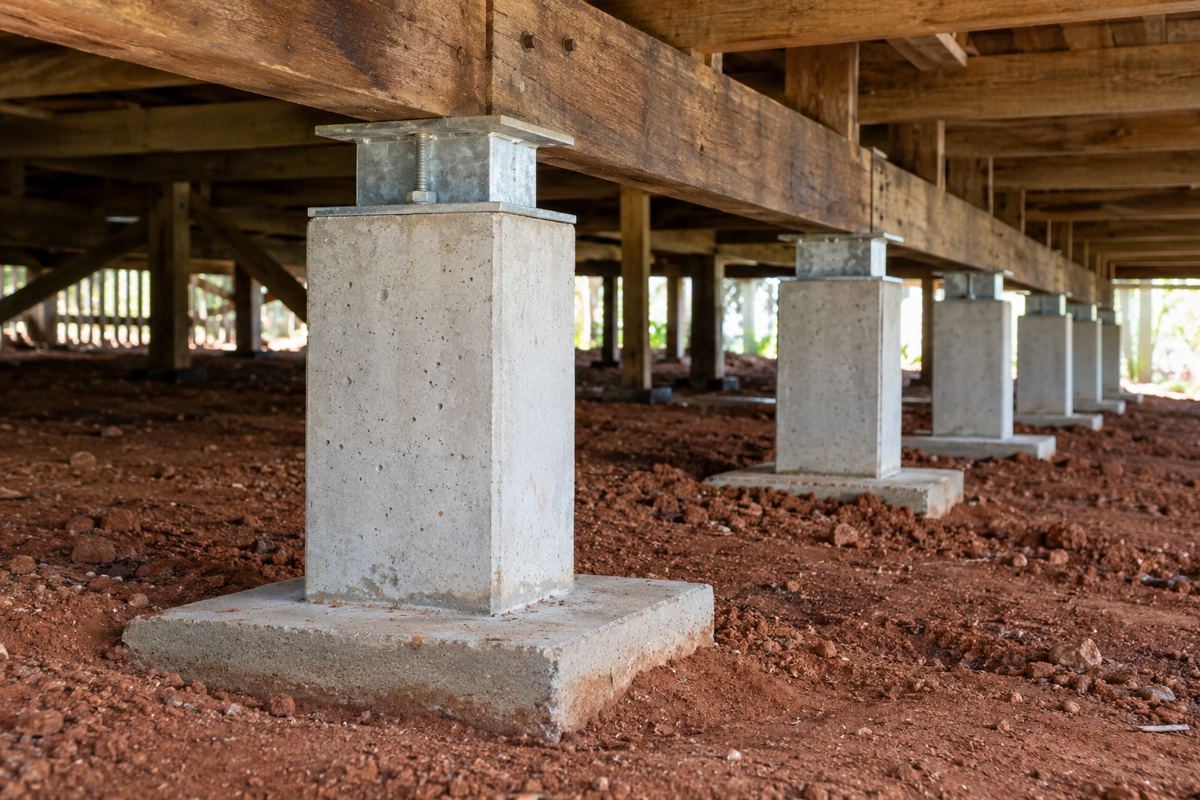
| Steel or concrete | Precast concrete is the usual choice. Galvanised adjustable steel costs more per stump and can be relevelled later with a spanner. The stump types page weighs them for clay and termites. |
| Raise or not | Restumping at the existing height is one job. Lifting the house to a new height for a build-under or a flood level is a house raise: engineer, surveyor, certifier and a different crew. |
| Bearers and joists | Rotted or termite-eaten timber replaced while the house is on jacks. Not known until the house is up, and often the biggest variable on a damp low-set subfloor. |
| Certifier and engineer | A full restump is assessable building work. The certifier's fee for the building development permit and inspections, plus an engineer where the clay or the design needs one. |
| Council | Council charges fees where it certifies, and for any application to build over or near a sewer, water or stormwater service. The amounts change each financial year, so ask council for the current figure. |
| Getting spoil and stumps out | A wide side drive and room for a truck, or every barrow through a narrow gate past a neighbour's fence on an older inner-city block. |
| Drainage | Regrading under the house, moving a downpipe, sometimes an agricultural drain on the high side. Small beside the stumps, and the reason the new stumps last on the clay. |
| Full or partial | Permit, set-up and relevelling are spread across the stumps done. Replacing a third now and the rest in three years usually costs more than doing them once. |
What the law adds, and when
Four Queensland thresholds change what the paperwork looks like, and a quote near any of them should say which side it falls on. The amounts here are the figures that applied in October 2026.
- Over $3,300: a licensed builder. QBCC requires a licence for building work valued over $3,300 including labour, materials and GST. Almost any restump passes that, so the builder must hold a QBCC licence in a class that covers it, which for a house is Builder Low Rise or higher. There is no restumping licence as such. The approvals page lists the classes and what an unlicensed job costs the person who does it.
- Over $3,300: home warranty insurance. The Queensland Home Warranty Scheme applies to residential building work over $3,300. The contractor collects the premium from you through the contract price and pays it to QBCC within 10 business days of signing and before work starts. Structural defects are covered for 6 years 6 months from the contract date, and the standard maximum is $200,000. Ask for the QBCC insurance notice; a quote that leaves the premium out is not comparable with one that puts it in.
- $3,301 to $19,999: a Level 1 contract. QBCC's contract levels require a written, dated and signed contract before work starts. A Level 1 contract covers the parties, the work, the price and the main terms.
- $20,000 or more: a Level 2 contract. Adds a start date, a fixed price or the method for working it out, the statutory warranties, and the Consumer Building Guide, which the builder gives you before you sign. A full restump on a larger Queenslander is often a Level 2 job.
Deposits are capped by the same rules. QBCC's deposit limits allow up to 20 per cent where the contract is $3,300 or less, 10 per cent on a Level 1 contract and 5 per cent on a Level 2 contract, with progress payments that have to match the work done. A restumper asking for a third up front on a Level 2 job is asking for more than the law allows. Over $3,300 you also receive a cooling-off notice with the contract.
If you were thinking of doing the work yourself, QBCC's owner-builder rules let you carry out building work on your own property up to $11,000 without a permit. Above that you need an owner-builder permit, which means a course, one permit every six years, no home warranty cover, a notice on the title for seven years and disclosure to any buyer within six years. Restumping is heavy, licensed work under a house, and in practice very few owners take that route.
Who else gets paid
The builder's quote is the big number. Around it sit the people the law puts on the job.
The building certifier. A full restump, any underpinning and any house raise is assessable building work under the Building Act 1975, and the building development permit comes from a licensed certifier. In Toowoomba you can use a private certifier or council's own building certification team; council's certification line is 4688 6828 and a duty certifier is at the Toowoomba Service Centre on Tuesdays and Thursdays. The certifier sets the fee for the permit and the mandatory inspections, so ask for it in writing. Where only a few stumps are being replaced the certifier may treat the work as accepted development; Logan City Council's fact sheet puts the line at 20 per cent of the structural components, and the certifier decides for your house.
The engineer. Underpinning always needs an engineer's design. A restump on the black clay, on a steep block near the escarpment, or where the house is being raised, may need a structural or geotechnical engineer to classify the site and design the footings. Council's own advice is that a geotechnical engineer may be needed to test the soil and design footings, and that a soil classification report is needed with plumbing applications.
Council. Council's fees and charges register sets the amounts for its own certification work and for applications such as building over or near a sewer, water main or stormwater pipe. This site has not verified the current amounts; ask council on 131 872 for the figure that applies to your job.
What a quote should name
After the inspection, not before. Over the phone a restumper can give a range from photos and a description. A quote that can be relied on comes after someone has been under the house, and it should say:
- How many stumps are being replaced, and whether that is all of them.
- What they are being replaced with: precast concrete, galvanised steel, or treated timber, and the footing under each.
- Whether the house is being relevelled at the same time, and to what tolerance.
- What happens to bearers and joists found rotted or eaten once the house is up: a rate per metre, or an allowance.
- Whether the price includes the certifier's fees, the engineer if one is needed, and the home warranty premium.
- Who removes the old stumps and spoil, and whether the under-house is regraded afterward.
- The contract level, the deposit, and the progress payments.
Two quotes with those items side by side can be compared. Two totals cannot. A low total that leaves out the certifier, the engineer and the premium, or that counts fewer stumps because the inspection was from the driveway, is not the cheaper job.
Where the money goes on the clay
On the red soil of the Range a restump is mostly labour and stumps. On the black clay of the Downs the ground itself moves the price. Holes go deeper so the stump bears below the zone that swells and shrinks with the seasons. Footings can be wider. An engineer may be asked to classify the site. And the drainage work that stops the clay under the house soaking after every summer storm, which the soils guide explains, is what protects the money spent on the stumps. A quote on clay that has no line for drainage is a quote worth asking about.
What this page cannot do
It cannot give a price, and no page can. A restump is priced on a stump count that only an inspection produces, on access that only a visit confirms, and on timber that is not seen until the house is on jacks. It cannot say what the certifier or the engineer will charge; each sets their own fee. It cannot give council's current fee amounts, which this site has not verified. And it cannot say which side of the $3,300 or $20,000 thresholds a particular job falls on, which decides the contract level and the deposit cap. For all of that, get the inspection done, read the quote against the list above, and ask for one.
Check the current rules before you rely on this
This page describes what moves the price of a restump in Toowoomba and what Queensland law adds at each value threshold. It describes the rules in general terms as they stood in October 2026. Standards, forms, thresholds and fines change.
The authoritative sources are QBCC, when you need a licence, QBCC, what is the Queensland Home Warranty Scheme, QBCC, domestic building contract levels, QBCC, deposits and progress payments, QBCC, owner-builder permits and Toowoomba Regional Council fees and charges. Where anything here differs from those sources, they are right and we are not.
We are not building certifiers, engineers, planners or lawyers. For what applies to your house, ask a licensed building certifier or ring Toowoomba Regional Council on 131 872.
Accurate at the time of writing, October 2026. Always check the source before relying on it.